


Next: 2-DOF Pole Placement Controller Up: 2-DOF Controller theory and Previous: 2-DOF Controller theory and
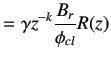
We want the desired output,  , of the system to be related to the setpoint
  in the following manner:
 |
 |
(6.14) |
 is the desired closed loop characteristic polynomial obtained from the desired region analysis.
Please refer to [1] for more information on desired region analysis. is the desired closed loop characteristic polynomial obtained from the desired region analysis.
Please refer to [1] for more information on desired region analysis.  is chosen such that equals
the setpoint at steady-state. Therefore is given by, is chosen such that equals
the setpoint at steady-state. Therefore is given by,
| ||
 |
 |
(6.15) |
|
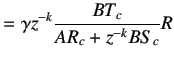
Simplifying the block diagram shown in figure 6.3 yields
| ||
 |
 |
(6.16) |
|
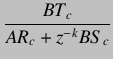
We have dropped the argument of  for convenience. We want the output for convenience. We want the output  of the system to be equal to the desired output . Equating equations 6.14
and 6.16 we get of the system to be equal to the desired output . Equating equations 6.14
and 6.16 we get
| ||
 |
 |
(6.17) |
|
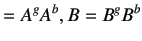
We can expect some cancelations between the numerator and the denominator polynomials in the LHS, thereby making 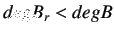 . But the cancelations, if any, must be between . But the cancelations, if any, must be between  poles and zeros. One should avoid the cancelation
of an unstable pole with an unstable zero. Let us split the factors of the numerator and denominator polynomials, poles and zeros. One should avoid the cancelation
of an unstable pole with an unstable zero. Let us split the factors of the numerator and denominator polynomials,  and and  , of the plant into , of the plant into  and and
 factors. Therefore, we write and as factors. Therefore, we write and as
| ||
 |
 |
(6.18) |
 and
and  as
as
 |
 |
(6.19) |
 |
 |
(6.20) |
 |
 |
(6.21) |
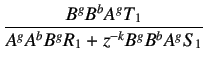
Hence, equation 6.17 becomes
 |
|
(6.22) |
|
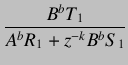
After cancelling out the common factors, we obtain
| ||
 |
|
(6.23) |
|
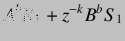
We obtain,
| ||
 |
 |
(6.24) |
 |
 |
(6.25) |
|
Equation 6.26 is known as the Aryabhatta's identity and can be used to solve for  and and  .
One can choose .
One can choose  in many ways. If we choose in many ways. If we choose  the 2-DOF controller is reduced to a 1-DOF controller. Let us
choose the 2-DOF controller is reduced to a 1-DOF controller. Let us
choose  . Therefore equation 6.25 becomes . Therefore equation 6.25 becomes
| ||
 |
|
(6.26) |
|
The expression for now becomes
| ||
|
 |
(6.27) |
|
and the desired closed loop transfer function will be
| ||
 |
 |
(6.28) |
